
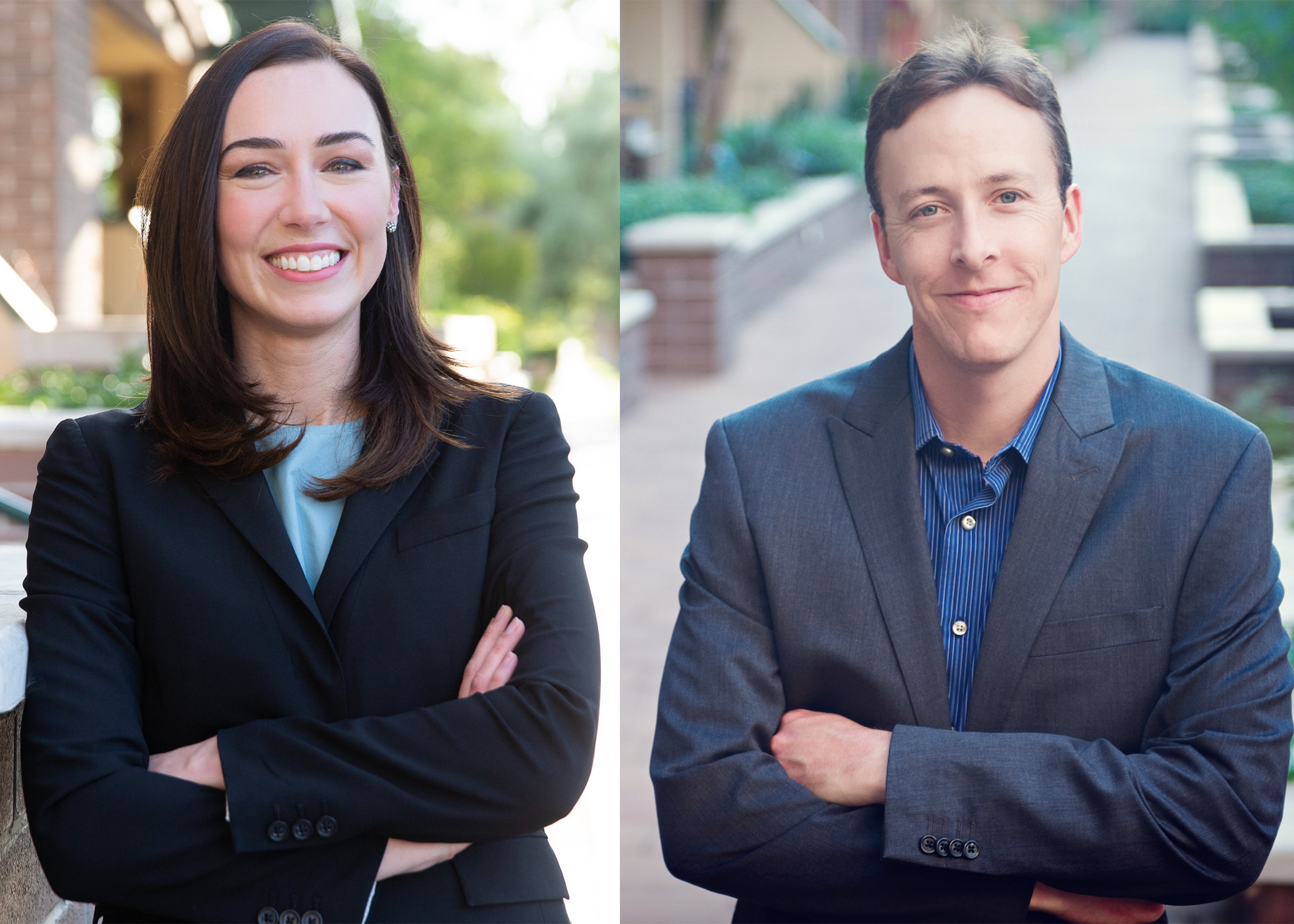
Scott Bennett, Marki Stewart Discuss Health Care Technology Trends in Presentation for State Bar of Arizona

Attorneys Scott Bennett and Marki Stewart recently broke down some of the health care community’s hottest legal trends in a Continuing Legal Education (CLE) seminar for the State Bar of Arizona. Scott addressed key developments in privacy law, including the California Consumer Protection Act and the General Data Protection Regulation (GDPR) of the European Union. Both laws affect how companies throughout the United States collect and store people’s personal information. Marki discussed key developments in the law related to telemedicine, including physician licensure issues, prescribing medications via telemedicine, reimbursement for telemedicine services, and federal enforcement actions related to telemedicine.  The State Bar of Arizona hosts a wide range of CLE seminars covering legal updates, skills-based workshops, and substantive legal topics. Programs feature local and national speakers including lawyers, judges, physicians, professors,...

Read MoreRead More


Roopali represents four initiative campaigns who filed a Petition for Special Action with the Arizona Supreme Court to seek an order permitting them to use the E-Qual system to obtain online signatures

KJZZ Taps Roopali Desai to Discuss Arizona’s Initiative to Legalize Recreational Marijuana

Representing the “Smart and Safe Arizona Act,” election attorney Roopali Desai was tapped by KJZZ News Radio to discuss the initiative to legalize recreational marijuana in Arizona.  Roopali explained that backers of the initiative ran the ballot language by legislative council members for feedback. She reinforced the significance of this review, noting that the 16-page initiative includes details about how the money from fines and civil penalties will be used.The hope is for the money to go toward community colleges, public safety, and other related programs. The legislative council’s recommendations will be used to revise the ballot language to ensure it is abundantly clear.  Roopali advises clients on all aspects of political and election law including campaign strategy, campaign finance compliance, disclosure and reporting requirements, and bringing and...

Read MoreRead More

Scott Bennett Reappointed Chair of American Health Lawyers Association’s Digital Health Affinity Group

With significant experience representing hospitals and other health care organizations, Scott Bennett has been reappointed Chair of the American Health Lawyers Association’s (AHLA) Digital Health Affinity Group, a subset of the organization’s Health Information and Technology Practice Group. Scott will serve a one-year term. As chair, he oversees four vice chairs who develop written publications and webinars. Scott also maintains communication with group members, informing them about important issues relating to health care technology.  “I’ve been involved with AHLA since 2016, and I’m eager to use my expertise in health care and security to help advance the Practice Group,” said Scott. “The health care industry is constantly evolving, and the educational resources that we provide attorneys are critical for staying informed about new regulations, technologies, operational efficiencies and best practices...

Read MoreRead More

Marki Stewart Joins Coppersmith Brockelman, Bolsters Firm’s Nationally Recognized Health Care Practice

We are pleased to announce that Marki Stewart has joined Coppersmith Brockelman. Marki is an art-loving, history-infatuated, die-hard gymnastics fan who dedicates her free time to learning about new trends in telemedicine and obsessing over Simone Biles. Marki helps hospitals, laboratories, surgical centers and other health care organizations navigate a variety of complex business and regulatory issues, including telemedicine, Stark Law and Anti-kickback Statute compliance, professional licensing, medical practice acquisitions, hospital-physician joint ventures, and HIPAA compliance. Marki has a special focus in telemedicine, assisting with licensing, reimbursement, credentialing, and data security issues. She is regularly tapped to share her telemedicine expertise with industry groups and trade publications as an author and speaker. Marki also represents health care providers in front of numerous boards and bodies, including the Arizona Medical Board, other...

Read MoreRead More
Roopali represents four initiative campaigns who filed a Petition for Special Action with the Arizona Supreme Court to seek an order permitting them to use the E-Qual system to obtain online signatures

KTAR Taps Roopali Desai to Discuss Canvassers Paying Phoenix Voters for Social Media Posts

Some promotional tactics related to Proposition 106 are stirring up controversy. To break down the legalities, KTAR news radio called on Roopali Desai, one of the state’s leading election and political law attorneys. The issue: a private group of Prop. 106 supporters is paying Phoenix voters to post “Yes on 106” to personal social media accounts. . If passed, Proposition 106 would mandate annual assessments of Phoenix’s pension debt and budget matters.  Roopali explained voters can express their personal support, but if they are paid to express a position, they should disclose they are being paid and by whom. She suggested that Arizona could require campaigns to disclose whether they pay people to advertise on personal social media, but she noted that no such law currently exists.  Roopali advises clients...

Read MoreRead More
Melissa Soliz Discusses Information Blocking in SHIEC Webinar Series

Melissa Soliz Discusses Impact of Data Privacy Laws on Opioid Epidemic with KTAR

Regulatory health care attorney Melissa Soliz explained how data privacy laws can impede effective treatment for opioid addiction in an interview with KTAR News Radio.  Melissa explained that 42 C.F.R. Part 2, the federal Confidentiality of Substance Use Disorder Patient Record regulations, limits how doctors and treatment centers can exchange information for treatment purposes. In many cases, the Part 2 regulations prevent providers from learning of a patient’s opioid addiction, and they may prescribe an opioid by mistake, triggering a relapse or overdose. An act of Congress is needed to remove Part 2’s barriers to effective treatment.  Melissa focuses her practice on HIPAA and 42 C.F.R. Part 2 compliance, data breaches and OCR investigations, electronic health records and health information exchanges, compliance with opioid treatment laws and...

Read MoreRead More